
Welcome back! Again, if this is your first time here, you can check out my first post to get more information. The prompt this week is about memes. Memes have been around for quite some time. They take not just the form of text pasted over an image, but also the forms of videos, specific phrases, and even charts. We can look closer at a meme to understand its rhetorical function. Let’s get started!

First I will be talking about an article we read for class titled “Subversive Memes: Internet Memes as a Form of Rhetoric” by Heidi Huntington. In her article, Huntington discusses what memes really are, as well as three different approaches to analyzing them. First is the semiotic approach that says that memes have meaning and can be interpreted as such. Second is the discursive approach which centers around the idea that knowledge is gained by using language (discourse). Finally we have the visual rhetoric approach which views memes as communicating through symbols. Another point Huntington brings up is that decoding a meme can reveal information about the time and place it was prevalent during.
In her conclusion, Huntington writes that “Memes are more than internet humor; research shows them to function by appropriation and resistance to dominant media messages” (3). For the most part, I agree with this. Yes, memes often are a collection of references to other memes or events (a meme has “layers”). They can be said to “appropriate” other content and remake it for a new purpose. However, as for “resistance to dominant media messages” I am not sure I agree with that. I would like an example of what she means. Furthermore, memes sometimes are just internet humor. They are created to make internet users laugh or smile. They are not always trying to convey a message (political or otherwise). Now we’ll take a look at a meme ourselves.
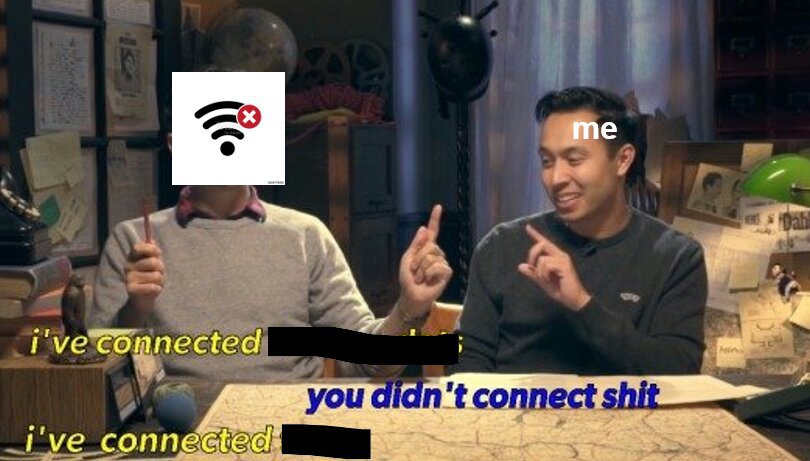
This was a popular meme a while back. As with all memes, this one allows people to use the basic frame and make their own joke with it. The one above is about WiFi (if that wasn’t obvious). The audience is smartphone users, or even people who use any device that needs to connect to WiFi. The message is that the WiFi symbol sometimes shows that the device is connected, but you know it actually isn’t. This meme is pretty surface-level compared to other memes, so it does not reflect a specific cultural context other than being targeted towards users of the internet.
I would love to hear if you have a favorite meme, so comment below and let me know! See you next week.
Clarissa
 WritinginSocal
Hey Clarissa! I really enjoyed reading about your thoughts on memes in response to the article. It was really nice to hear a point of view similar to my own! I also believe that while some memes can be used as more than just dumb humor, at the end of the day, I think that a lot of memes are used for just a laugh. I think that the wifi meme example you put in your post is a perfect example about how a meme can be used a just a dumb joke. Also, in response to your question, my favorite meme would have to be any meme involving ratatouille, i don’t know why, but they make me laugh.
LikeLiked by 1 person
Hi Clarissa! I absolutely love the meme you chose to analyze for this post. Wayyyyy too many times have I been in a coffee shop where the network has claimed connection but actually just left me in the dust (and needing to use my own personal hotspot to do work). I really enjoy memes like this that aren’t that deep since they seem to connect to a wider audience instead of narrowing it down to a particular group or commenting out of a specific context. To answer your question, I love science memes of course (just biochem major things!) but I also like any Spongebob memes (I don’t think I’ve ever seen one that isn’t funny). One personal favorite is when the trend of photoshopping him in a bunch of different locations with matching music. So good. Great read! ♡
LikeLike